Thursday, 28 December 2017 16:30

Democrats Just Won a Major Victory in Virginia
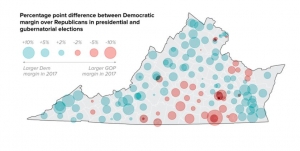
On a night of Democratic victories, one of the most significant wins came in Virginia, where the party held onto the governor’s mansion. Democratic governor-elect Ralph Northam’s victory will enable him to expand voting rights to disenfranchised people and exert some control over the redistricting process.

The Virginia Supreme Court rejected a petition from Republican leaders on Thursday that sought to hold Virginia Gov. Terry McAuliffe (D) in contempt for restoring the voting rights of tens of thousands of ex-offenders ahead of the 2016 election.

Virginia Senate Majority Leader Thomas K. Norment Jr. announced Thursday that he’ll introduce a constitutional amendment to automatically restore voting rights for some nonviolent felons, create new barriers for others, and strip future governors of the power to restore political rights.

On Tuesday the Virginia Supreme Court heard arguments in a suit challenging Gov. Terry McAuliffe’s (D) April order that restored voting rights to 200,000 Virginians with past felony convictions. While the court proceedings will stick to legal arguments, the public debate has been needlessly rancorous and partisan.

Along with the state officials and law professors who are happy that the Supreme Court this week is reviewing the corruption conviction of former Virginia governor Robert F. McDonnell, add inmate No. 24775-001 at the federal prison in Oakdale, La.

Published in Criminal Injustice

The Equal Rights Amendment cleared the floor of the Virginia Senate for the fifth time in six years. SJ1, sponsored by Senator Scott Surovell (D-Fairfax), passed 21-19 on Tuesday on a near-party line vote with most Senate Republicans opposed​.

If you know Guys & Dolls, you’re already singing the rest of this line: “His name is Paul Revere, and there’s a guy that says, when the weather’s clear, ‘Can do!’” - http://www.musictory.com/music/Guys+And+Dolls/Fugue+For+Tinhorns )

The name of JEB Stuart High School should be changed because “along with the name, comes a history of racism, inequality, and oppression,” Stuart senior Lidia Amanuel told the Fairfax County school board Dec. 17 at a public hearing on a proposal to change the board’s policy on school names.

Stuart is a diverse school with students from more than 70 countries, and “many of us don’t identify with the ideals of the Confederacy that JEB Stuart stood for,” Amanuel said. Changing the name would end the school system’s “tolerance of institutionalized racism.” 

Later that evening, the school board voted unanimously to adopt a new policy on school names. The measure, proposed by board member Sandy Evans (Mason), doesn’t specifically address Stuart High School, which is named for a Confederate general, or any other school, but it does clear the way for such a proposal to be introduced later.
 
Under the current policy, school names can only be changed if the use of the building changes. “This modest revision would permit the school board to change a name if there is a good reason to do so,” Evans said.
 
During the board discussion before the vote, at-large member Ted Velkoff said he supports the goal of eradicating racism and honoring U.S. Supreme Court Justice Thurgood Marshall, as many of those who support a name change for Stuart recommend, but warned against a wholesale renaming of schools, noting “Civil War history is complicated.”
 
The possibility of having two high schools named Marshall “could potentially be a stumbling block,” he said.  The other one is named for Gen. George C. Marshall. Instead, he suggested naming an elementary or middle school for Thurgood Marshall.
 
“There is no way we’re going to have two Marshall high schools,” said board member Elizabeth Schultz (Springfield). She proposed renaming Stuart for former President Ronald Reagan, citing his leadership in establishing a national holiday honoring Martin Luther King. She also warned against going too far in changing names, although in the end she voted for the policy change.
 
Everyone who spoke at the public hearing urged the school board to change the name of Stuart High School to honor Justice Marshall.
 
Stephen Spitz, a Lake Barcroft resident and retired civil rights and constitutional law attorney, said, “Justice Marshall was not only the leading advocate arguing for the abolition of racial segregation in Brown v. Board of Education, but was also a legendary defender of equal protection of the laws for everyone. He is the perfect symbol of the diversity of the student body at the high school and would be a wonderful inspiration to the students, the faculty, the administration, the staff, and the larger community.”
 
“Make no mistake. JEB Stuart High School was not named to honor a Confederate general’s role in the Civil War,” Spitz said. ”The school was named as part of Virginia’s ‘massive resistance’ to school integration.”
 
After the Supreme Court ruled unanimously in Brown that separate schools for black and white students were inherently unequal and therefore unconstitutional, segregationists who controlled the government in Virginia, “were determined to defy the Brown decision,” he said.
 
During that period, recounted in the new book, A Nation of Nations: A Great American Immigration Story, by Tom Gjelten, Virginia mandated the closure of any school under an integration order and cut off state funding for any school that attempted on its own to integrate, Spitz said. “When the school board in Arlington County dared to propose a modest integration plan, the state board of education rejected the plan and fired the entire Arlington board.”
 
“Fairfax County officials did not merely refuse to comply with the Supreme Court’s order, they defiantly named their next two high schools after Confederate Army generals: JEB Stuart and Robert E. Lee,” he said.
 
Spitz urged the school to rename Stuart High School for Justice Thurgood Marshall “to help Fairfax County move forward into the 21st century instead of continuing to honor its troubled past.”
 
Jessica Swanson, who lives near Stuart, also called upon the school board to rename the school for Marshall, noting he was a longtime foe of segregation, chief architect of the legal strategy to end segregation, argued the Brown case before the Supreme Court, and was the first African American Supreme Court justice.
 
Marshall dedicated his life to bringing us together,” Swanson said, and was not, like Stuart, “dedicated to fighting to tear us apart.”
 
Changing the name of a school may seen a low priority compared to budget cuts and achievement gaps, “but small indignities matter, symbolism matters,” said Tina Hone, a former school board member and head of the Coalition of The Silence, a group advocating for minority students.
 
The anti-integrationists who chose the name Stuart “knew exactly what it symbolized,” Hone said. “Naming the school after the late great Supreme Court Justice Thurgood Marshall, who lived in one of the neighborhoods that feeds into Stuart and who through his leadership in Brown v. Board of Education, changed the face of public education in this nation, would be the right symbolism.”
 
While some may say the name should be changed to honor a prominent Latino given the makeup of the school’s student body, Hone said, the civil rights victories won by Marshall “set the precedents on which the rights of nearly every minority community stand.”
 
Mike O’Brien, a member of the board of the Fairfax County NAACP, said a school named for a Confederate general is no longer appropriate in 2015.
 
The only good reasons to name a school for an individual are to honor someone whose values benefit the community or whose accomplishments serve as an inspiration, O’Brien said.
 
Stuart, on the other hand “fought in open rebellion against the government of the United States in support of slavery,” he said. Stuart High School has a significant number of students of color, and the messages they might absorb from the name of their school are,” You are less than equal than your white counterparts here,” and “this county still has a grudge against those who won the Civil War.”
 
The messages that the school should convey, he said, are, “we are all equal here and we are all worthy.”
 

As states across the country are relaxing their marijuana laws and federal lawmakers consider doing the same, at least one state is bucking the trend and ramping up its war on pot. Marijuana arrests in Virginia have increased dramatically over the past decade, according to a new report from the Drug Policy Alliance, a group that advocates for drug policy reform. And black Virginians account for the overwhelming majority of this increase, causing the racial disparity in the state's marijuana arrests to widen.

It's fascinating what a little coordination - and a lot of communication - can do in battling homelessness among veterans.

Published in End Homelessness Now

Virginia Gov. Terry McAuliffe said Tuesday that he will phase out a state-sponsored license plate featuring an image of the Confederate flag.

Felons who've served their time and want their voting rights restored won't have to pay outstanding court costs anymore as part of the deal, Gov. Terry McAuliffe announced Tuesday.

Virginia Democrats asked the federal court system Thursday to overhaul state voting procedures, accusing the state's Republican leaders of purposefully rigging the system against young, minority and Democratic voters.

It’s the cusp of his 90th birthday, but civil rights icon Ferguson Reid is still gearing up for the long haul.

“We have the races in 2015, 2017, and 2019 to get the majority,” he tells me, referring to the off-year elections for control of Virginia’s state government. “And this election will determine whether or not we’re able to get a House majority for 2021.”


The Virginia Constitution does not allow anyone with a felony conviction to vote unless their rights have been restored by the governor. But on Friday, Virginia Gov. Terry McAuliffe (D) announced he would immediately restore voting rights to anyone who has completed their sentence for a drug offense, and reduce the waiting period for other violent felonies from five years to three.

It’s the cusp of his 90th birthday, but civil rights icon Ferguson Reid is still gearing up for the long haul. “We have the races in 2015, 2017, and 2019 to get the majority,” he tells me, referring to the off-year elections for control of Virginia’s state government. “And this election will determine whether or not we’re able to get a House majority for 2021.”

Tuesday, 17 February 2015 00:00

Virginia still deciding if women are equal

RICHMOND — In 1972, when Congress passed the Equal Rights Amendment and asked states to ratify it, “The Godfather” was No. 1 at the box office, people talked on rotary telephones and women made up about one-third of the U.S. workforce.

Thursday, 05 February 2015 00:00

Virginia GOP Rescinds and then Passes the ERA

UPDATE: On February 5th the Virginia Senate passed SJ 216 after rescinding passage on February 3rd. The status of the bill lin the Virginia Legislature is available here. The bill will move to the House during crossover.

Gov. Terry McAuliffe (D) on Tuesday unveiled plans for a 550-mile natural gas pipeline through three states, a proposal that won him kudos from the energy industry but criticism from environmental activists, who had considered him an ally.

Published in Zero Climate Emissions

(The Root) -- In 1994 Kemba Smith was sentenced to 24 1/2 years in prison after she pleaded guilty to conspiracy in a cocaine ring. The story of the harsh punishment dealt to a minor player -- who admitted to lying and breaking the law for her abusive boyfriend but never used or sold drugs -- caught the attention of criminal-justice advocates across the country.

James W. Ray sat silently in the front row of the church meeting room, rubbing his eyes. Ray wasn’t mourning a loss. Rather, the Vietnam veteran and felon wept over something that had just been returned to him — the right to vote.

The Republican electoral sweep in yesterday’s elections has put an end to speculation over whether new laws making it harder to vote in 21 states would help determine control of the Senate this year. But while we can breathe a sigh of relief that the electoral outcomes won’t be mired in litigation, a quick look at the numbers shows that in several key races, the margin of victory came very close to the likely margin of disenfranchisement.

With midterm hangover setting in, many will chatter and finger-point into next month about what happened, who did what and why. And at the center of it will be questions about the black vote. In crucial Senate and gubernatorial races where the black vote was needed most—Arkansas, Georgia, Kentucky, Illinois, Louisiana, Maryland, North Carolina—Democrats faced humiliating blows to the stomach.

This week the Durham, North Carolina-based nonprofit MDC released its latest State of the South report highlighting how the American dream of intergenerational upward mobility is more elusive for young people born at the bottom of the income ladder in the South than anywhere else in the country.

A group of his constituents met last week with Del. Michael J. Webert (R-18th/Marshall) to tell him how lack of adequate health care affects them and to enlist his support for a solution. From all ages and walks of life, they met Thursday, Aug. 7, at the cooperative extension service office in Warrenton.

Published in Expand Medicaid NOW!

Mercedies Harris strolls down the halls of the Hollaback and Restore Project, a felon rehabilitation center in rural Virginia, and points to a baby-faced 18-year-old with a timid gait. “This is a fine young gentleman who got into a little trouble,” he explains. “And we are working with him to try to stop him from being a statistic and being incarcerated and having a record. He’s going to learn to be a barista. And if he gets good, he’ll be known for it,” he chuckles. “People will be coming here to get his coffee.”

About 200,000 voters in Virginia may lack the proper identification needed to cast a ballot in the November midterm elections, state election officials said Thursday.

Under a state law that took effect this year, Virginia voters must present a driver’s license or some other form of photo identification at their polling stations before they cast a vote.

Page 1 of 3

Latest News

  • Trump administration's voter suppression attempts ahead of midterms are not only 'morally wrong,' they're illegal +
    Trump administration's voter suppression attempts ahead of midterms are not only 'morally wrong,' they're illegal Imagine going to the polls on Election Day and discovering that your ballot could be collected and reviewed by the Read More
  • ACLU Blueprints Offer Vision to Cut US Incarceration Rate in Half by Prioritizing 'People Over Prisons' +

    ACLU Blueprints Offer Vision to Cut US Incarceration Rate in Half by Prioritizing 'People Over Prisons' ACLU Blueprints Offer Vision to Cut US Incarceration Rate in Half by Prioritizing 'People Over Prisons' Read More
  • As Florence Makes Landfall, Poorest Once More Likely to Suffer Most From Storm's Destruction +

    As Florence Makes Landfall, Poorest Once More Likely to Suffer Most From Storm's Destruction "These disasters drag into the light exactly who is already being thrown away," notes Naomi Klein Read More
  • How about some good news? Kansas Democratic Representative advances bill for Native Peoples. +

    How about some good news? Kansas Democratic Representative advances bill for Native Peoples. How about some good news? Kansas Democratic Representative advances bill for Native Peoples. Read More
  • How One Dying Man Changed The Debate About The Tax Bill +

    How One Dying Man Changed The Debate About The Tax Bill What mattered was that he showed up — that he put himself in front of the people whose opinions on Read More
  • Democrats Just Won a Major Victory in Virginia +

    Democrats Just Won a Major Victory in Virginia On a night of Democratic victories, one of the most significant wins came in Virginia, where the party held onto Read More
  • Repealing the Jim Crow law that keeps 1.5 million Floridians from voting. +

    Repealing the Jim Crow law that keeps 1.5 million Floridians from voting. A seismic political battle that could send shockwaves all the way to the White House was launched last week in Read More
  • Nuclear Weapons: Who Pays, Who Profits? +

    Nuclear Weapons: Who Pays, Who Profits? In an interview with Reuters conducted a month after he took office, Donald Trump asserted that the U.S. had “fallen Read More
  • Sessions issues sweeping new criminal charging policy +
    Sessions issues sweeping new criminal charging policy Attorney General Jeff Sessions overturned the sweeping criminal charging policy of former attorney general Eric H. Holder Jr. and directed Read More
  • 1
  • 2